The Balcerowicz Plan still functions in Polish public debate as a shorthand: on the one hand, as a symbol of 'necessary' shock therapy, and on the other, as a turning point after which the costs of transformation were borne primarily by working-class groups.
In left-wing circles, the topic returns regularly because many disputes about the 1990s boil down to the question of whether this direction of reform was the only possible one and who actually benefited from it in practice. If someone is looking for a concise introduction to what the plan looked like and how it was justified, a good discussion is presented by the Pro Publico Bono channel on YouTube in their film.
Regardless of the assessments, the systemic transformation—the introduction of a capitalist economy in Poland—had very concrete, everyday consequences. Most Poles (starting from the millennial generation) remember the problems and pathologies of that period, even if some consider it a 'necessary evil.' Let's briefly recall the 'charms' of the 1990s:
- the collapse of large workplaces;
- double-digit unemployment and impoverishment of entire cities and regions;
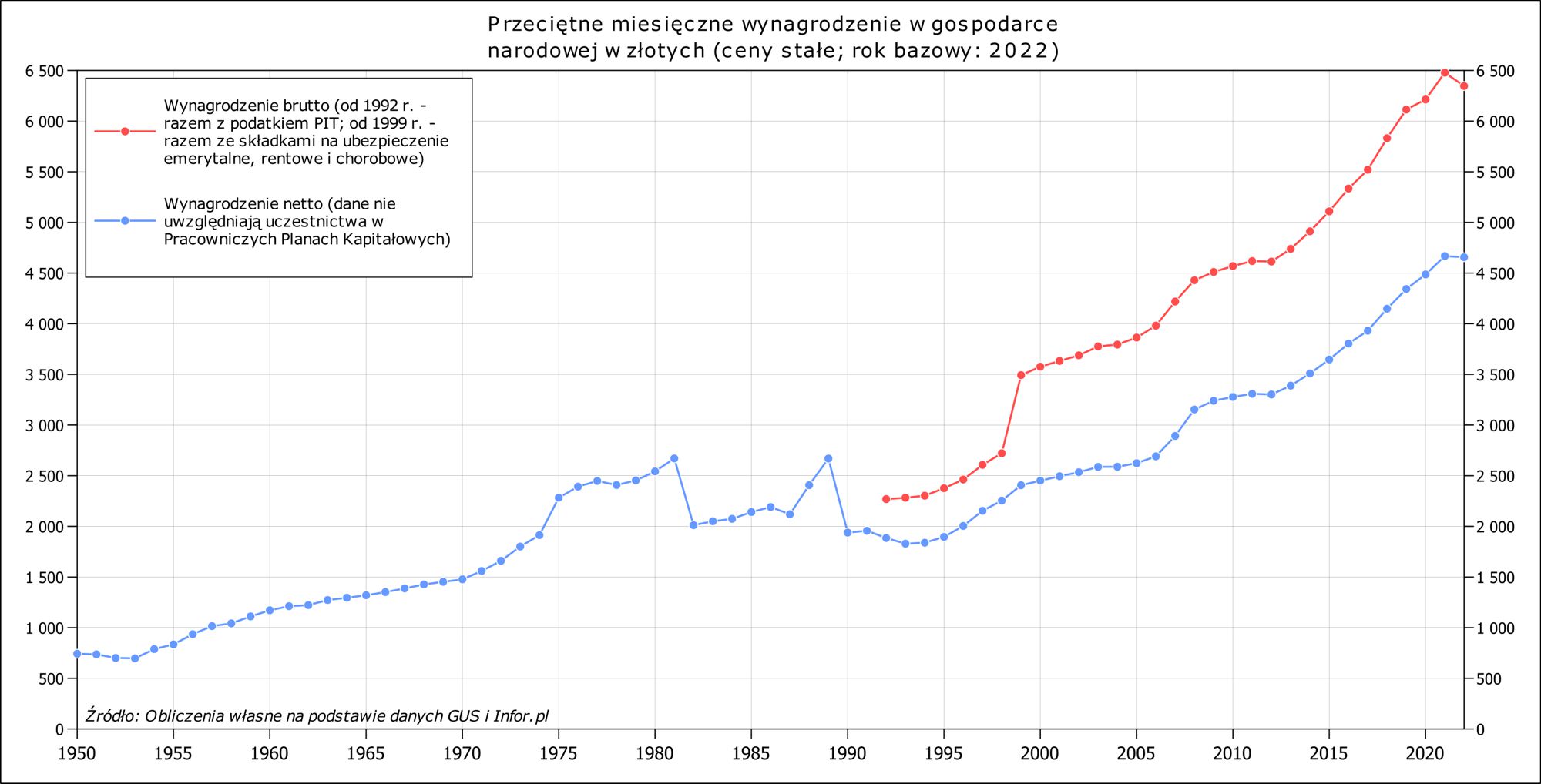
- a drop in real wages (real wages returned to the level of the late 1980s only in the early 2000s);
- an increase in poverty;
- a sharp rise in homelessness;
- the flourishing of organized and petty crime;
- an increase in prostitution.
This Reddit thread captures the realities of that time well—with a touch of ironic sentimentalism.
Liberal apologists for Balcerowicz, however, have their own arguments—most of which boil down to various versions of one of two slogans: 'there was no other way' or 'it wasn't that bad.' A polemic against these kinds of theses (especially in relation to macroeconomic indicators such as GDP per capita) was undertaken by Professors Kołodko and Nuti in section V of the paper 'The Polish Alternative: Old Myths, Hard Facts and New Strategies'.
In this text, I look at several statements regarding the impact of the Balcerowicz Plan on the material situation of the Polish working masses—particularly the working class.
'Unemployment growth was overestimated'
This thesis was defended by one of the actual architects of the plan—Jeffrey Sachs. According to him, real unemployment in 1994 was 'only' about 10%, not the official 15% (or rather 16%), because some of the unemployed were moonlighting in the grey sector. Counterarguments come to mind:
- A 10% unemployment rate is still high;
- The widespread nature of 'under the table' work (and thus low-paid, temporary work not covered by code protection) indicates the impoverishment of the working class;
- In reality, we were dealing with so-called hidden unemployment, including the 'pushing out' of workers onto early retirement, pensions, pre-retirement benefits, etc., as Kołodko and Nuti aptly point out:
The 'true' unemployment rate should have included those involuntarily withdrawn from the active population: the early retired and pseudo-invalids pensioned off instead of being sacked, plus those unemployed who, no longer being entitled to benefits, failed to register
'The drop in wages was overestimated'
A smaller than official drop in wages was supposed to be evidenced by a relatively small drop in consumption. This would mean that people compensated for lower wages in the 'official' economy (or their complete loss) by 'moonlighting.' This explanation, however, does not remove the problem: the widespread nature of 'under the table' work is itself an indicator of the impoverishment of the working class—especially if people had to work longer and in worse conditions to maintain consumption at a level similar to previous years.
Moreover, the drop in consumption could be 'offset' not only by taking on additional, temporary employment but also, for example, by selling possessions or turning to the 'underworld.' This indicates rather the desperation of a significant part of society than the 'cosmetic' nature of the problem. Despite these reservations, it should be emphasized that the drop in consumption in the early 1990s was very real:
These statements are contradicted by Sachs's own data; it has taken until 1993 for food consumption per capita to approach the 1989 level
'The drop in the standard of living in the 1990s compensated for the time lost in queues during the PRL period'
As Małgorzata Raczkowska states:
The time spent daily on shopping decreased for women on average from 2.4 hours in July 1989 to 0.7 hours in July 1990 (similar numbers for men showed a decrease from 1.9 hours to 0.66 hours).
Unfortunately, the deterioration of the standard of living often forced Poles to use the saved time to take on additional employment or—worse—to stand in line at the job center.
As Kołodko and Nuti aptly note:
The search for goods had been replaced by the search for jobs, with one giant queue of unemployed replacing the innumerable queues for goods, while the welfare of employed workers was worsened by job insecurity
What is more important, the problem of consumer shortages in shops was a direct result of maintaining artificially low prices. The adjustment of prices at the end of 1989, i.e., before the start of the Balcerowicz reforms (and immediately after the moment used by Raczkowska as a reference point), effectively reduced the phenomenon of shortages, as Kołodko and Nuti rightly point out:
By the autumn of 1989 shortages in Poland had been virtually eliminated
'Poland fared best in the transformation among all the former Eastern Bloc countries'
The basic problem with this thesis is that it reduces the complex, nearly 40-year history of the Third Polish Republic to one factor: the economic reforms of its early period. It thus omits the role of subsequent governments in shaping Polish reality. Such reasoning has a downright caricature-like character, and its fundamental errors were demonstrated, among others, in Leon Podkaminer's short article 'If Not for Kołodko.'
However, it is worth adding that when we look at the situation of other post-socialist countries, we quickly come to the conclusion that the group of countries with which Poland can be compared is surprisingly narrow. Above all, it makes no sense to compare Poland with the countries of the former Yugoslavia—it is difficult to expect that countries ruined by wars and genocides in the 1990s could compete with us economically.
As a sensible point of reference, we should also reject two other, clearly poorer countries in the region—Bulgaria and Albania. Comparing ourselves with the former Soviet republics also does not contribute much, considering the scale of the socio-economic catastrophe that affected them in the 1990s as a result of the collapse of the USSR (including more than one war).
Realistically, we are left with a maximum of four countries (mostly much smaller than us) in Central and Eastern Europe with which we can sensibly compare ourselves: the Czech Republic, Slovakia, Hungary, and Romania. Being the leader of such a group does not seem like a particularly high achievement—even if we wanted to attribute it to Balcerowicz for the sake of discussion.
Summary
There is no doubt that the Balcerowicz reforms resulted in significant impoverishment of the Polish working class. Moreover, they caused a regression in the sphere of means of production: often modern industrial plants were liquidated, and the gap was filled by 'januszexes'—small and medium-sized, domestic private enterprises of little economic value.
The result of the restoration of capitalism in Central and Eastern Europe was the reduction of this region to the status of a peripheral, almost semi-colonial area: economically and politically dependent on Western Europe, being a source of cheap labor for Western capitalists and a market for German and French retail chains. As a result, both Poland and our southern neighbors lost some of their subjectivity on the international stage, entering into a relationship of vassalization towards Western powers.

It is worth emphasizing that at the end of the 1990s, Balcerowicz managed to repeat the 'success' of causing a sharp increase in unemployment—this time, however, the previously used set of excuses (end of trade with the USSR, the first Gulf War, political changes, etc.) cannot be applied.
However, this critique of the transformation of the 1990s should not be read as unreflective sentimentalism towards the late PRL period. It is worth emphasizing that this vassalization towards Western imperialism was a direct consequence and continuation of the PZPR's policy, starting with the famous Gierek debts incurred at the end of the 1970s, as described in detail by Jacek Tittenbrun in the monumental work 'The Fall of Real Socialism in Poland.'
It is therefore no coincidence that the last 15 years of the PRL were associated with stagnation and a deterioration in the standard of living of the Polish working class. The scale of economic liberalization in the late PRL even raises the question of whether the restoration of capitalism in Poland should not be dated a few years earlier than the commonly accepted year 1989—as described in detail in the aforementioned work.
In this context, the changes of the 1990s undoubtedly deserve the term used by the same author as the title of a series of books on the subject: 'out of the frying pan into the fire.'